Keep a favorite frame
How to Choose Art for an Oval Frame Without Losing the Subject
Choose the image through the frame’s visible opening before ordering a print. An oval can hide important corners even when its overall width and height match the image, so compare the crop before changing the artwork.
A favorite oval frame can be a good reason to start looking for a picture. It also asks a more specific question than “what print size fits?” You need a composition that survives the curved opening, plus the correct physical fit confirmed separately.
This guide helps you select the image and communicate the result. The paper-window comparison below is a planning exercise; it does not require cutting, attaching or altering an original artwork.
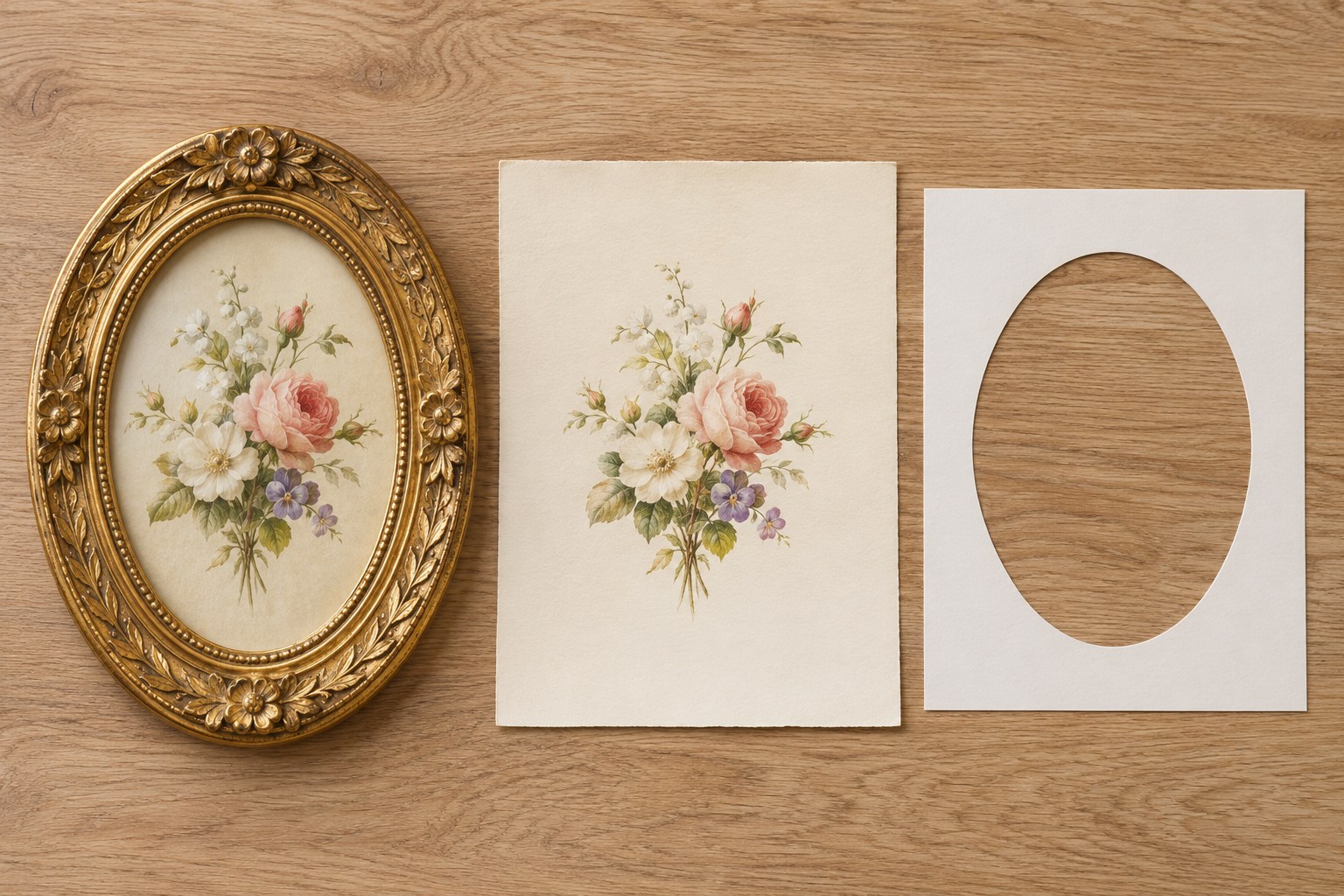
Record three different measurements
Before searching for art, separate the outside frame dimensions from the visible opening and the fitting requirements. Photograph the frame front-on and record the widest and tallest parts of the opening you can actually see. Note any unusual pinching, decorative projection or irregularity in the shape.
- Outside dimensions: the whole frame, used later to plan its position on the wall.
- Visible opening: the area through which the picture is seen.
- Fitting requirements: the actual sheet, support and depth the frame can accommodate; confirm these with a framer before ordering.
Those measurements serve different purposes. Do not order a print from the outside dimensions alone, or assume the visible opening tells you the required paper size. An old frame can have an opening that differs from a mathematically perfect ellipse, so a generic oval preview is only a first check.
Shortlist compositions with room at the corners
Begin with the subject you want to keep visible. A centered flower spray, portrait or single object with surrounding space is often an easier first comparison than a scene whose important details occupy all four corners.
That is a composition choice, not a rule that oval frames must contain portraits. A landscape can work if the part you love survives the window. A floral print can fail if the best bloom sits near a corner. Look at the flat artwork preview rather than assuming the seller’s rectangular frame mockup shows the crop you will receive.
For text, signatures, botanical labels or a decorative border, mark every element you consider essential. If an oval removes one of them, decide whether you actually like the changed image. Do not quietly crop away the reason you chose the picture.
Understand why matching width and height is not enough
An oval that is 8 inches wide and 10 inches tall does not show every part of an 8 × 10 rectangle. Its full width exists only across the middle; the sides narrow towards the top and bottom.
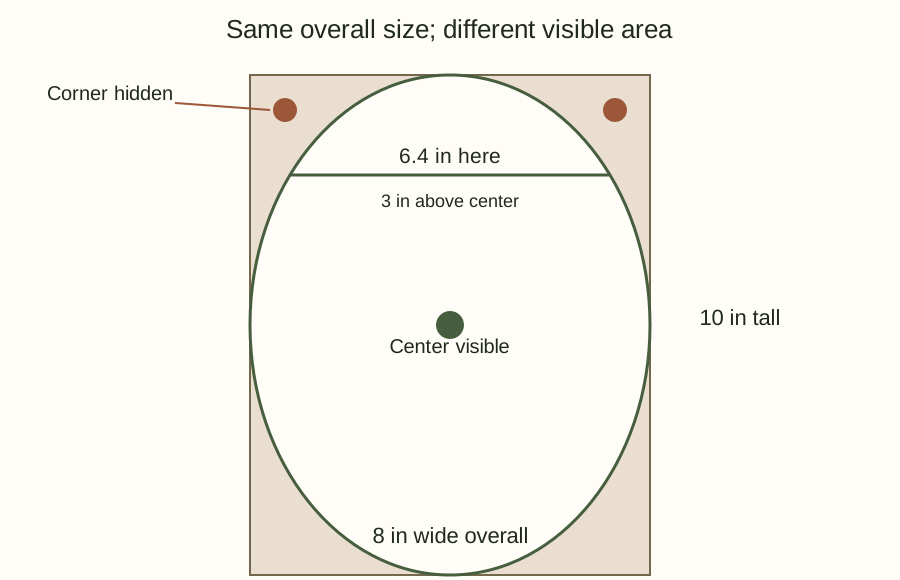
For a mathematical ellipse measuring 8 × 10 inches, a horizontal slice 3 inches above its center is only 6.4 inches wide. That calculation illustrates the narrowing; it is not a recommended overlap, a print size or a specification for your frame. Use your actual opening for the final visual check.
A print’s rectangular aspect ratio therefore cannot settle an oval crop by itself. You need to see where the subject falls within the opening.
Make a separate window preview before buying or trimming
- Draw the visible opening on a separate sheet. Use measurements or a careful drawing of the shape without dismantling or pressing paper against a delicate frame. Ask a framer to record it if access is difficult.
- Make a window in that separate sheet. Keep it away from original art. This paper mask is a viewing aid, not a mounting material or a template for cutting the artwork.
- Compare an authorized preview. Use the seller’s permitted image, a purchased file under its terms or artwork you own. Do not remove watermarks or reproduce restricted previews.
- Try the intended image scale. Compare the subject within the opening. Record any shift or enlargement, then check all the essential details again.
- Keep the chosen preview with your notes. Confirm the actual sheet and fitting dimensions with the printer or framer before ordering.
If you work on screen, overlay the opening shape on a copy of a permitted image and preserve the original file. A screen preview helps you choose a composition; it does not verify physical fit or print quality. Make a permitted proof at the intended scale when you are ready to confirm the result.
Compare three fixes when the crop fails
Swipe or scroll sideways to compare the choices.
| What the preview shows | Useful comparison | What to avoid assuming |
|---|---|---|
| Subject fits, but the margin feels uneven | Try a small position change and compare the visual center | That exact geometric centering always looks best |
| Important corners or labels disappear | Try a smaller image on a larger permitted background, or choose a different composition | That every file can be expanded or altered without changing its appearance or permissions |
| The whole composition needs its rectangular border | Keep that image rectangular and choose another for the oval | That using a beloved frame requires sacrificing a beloved image |
Do not stretch the image into an oval. The opening can hide the surrounding paper while the subject keeps its original proportions. If resizing makes fine details too small, compare a different image rather than relying on the frame to solve it.
Keep fitting and preservation decisions separate
The preview solves what you want to see. It does not tell you how to secure the work, which glazing to use or whether an old frame is in suitable condition. Give the framer the frame, the intended image and the preview notes, and ask about the complete package.
For paper works, the Library of Congress preservation guidance calls for stable framing materials, adequate depth and separation between the work and glazing. Ask a qualified framer or conservator about an old, valuable or fragile object before disassembly, trimming, taping or other changes. A decorative paper-window test does not establish a conservation method.
Textiles, thick objects and already-mounted paintings have different fitting needs. Do not transfer this paper-print selection exercise into instructions for cutting or mounting needlework.
Take this brief to the printer or framer
- Frame
- Outside width and height: ______ Condition or access concerns: ______
- Visible opening
- Widest width and tallest height: ______ Irregular areas: ______
- Image details that must remain
- Subject, labels, signature or border: ______
- Preferred preview
- Image scale and position: ______ Permitted proof checked: ______
- Fitting questions
- Required sheet dimensions, support, glazing and depth confirmed by: ______
- Decision
- Keep image / choose another composition / use this image in a rectangular frame: ______
After the image and frame are resolved, use our guide to arranging pieces you already love to place the finished oval with other objects. Keep that wall-layout decision separate from the opening inside the frame.