Gallery walls
How to Build a Gallery Wall Around Art and Objects You Already Love
Start with the pieces that must stay, use them as anchors, and add only what you need to balance them. Two large favorites go at the ends with small prints between; a mirror goes in the center with calmer art either side; an odd-shaped clock goes off-center, balanced by a rectangular group. Test two full-size paper-template layouts before buying anything new.
You don't need a new set of art. You need a plan for the pieces you already love.
Two big paintings you inherited, a mirror that came with the apartment, a clock you can't part with, a canvas that suddenly looks too small: these are the real starting points for most gallery walls. Here's how to build around them, with annotated layouts for each situation and a simple test before you buy anything else.

Where do you start when you already own pieces you love?
Sort everything into "must stay" and "can move", and build the wall around the must-stays.
Most gallery wall advice assumes a blank wall and a shopping list. Real walls start with two big paintings from a grandparent, a mirror that came with the house, a clock you can't part with, or a canvas that suddenly looks too small. Those are your anchors, not problems.
- Must stay: the pieces you won't remove. Note each one's size, shape and how heavy it looks (dark or pale, bold or soft).
- Can move: pieces that could go on another wall, or be re-framed.
- To add: only what you need to balance the must-stays, and decide that last.
How do you arrange two large favorite pieces?
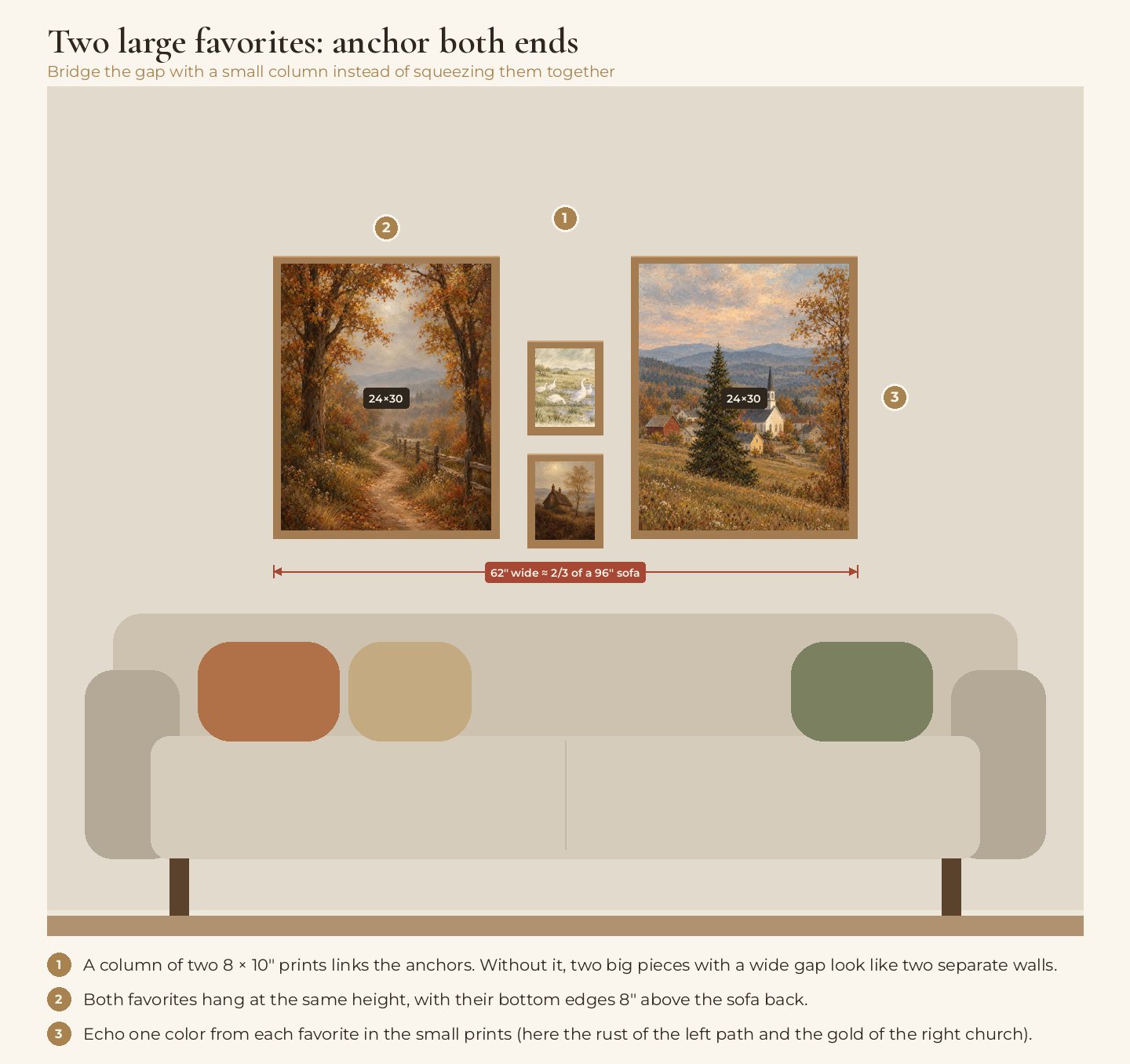
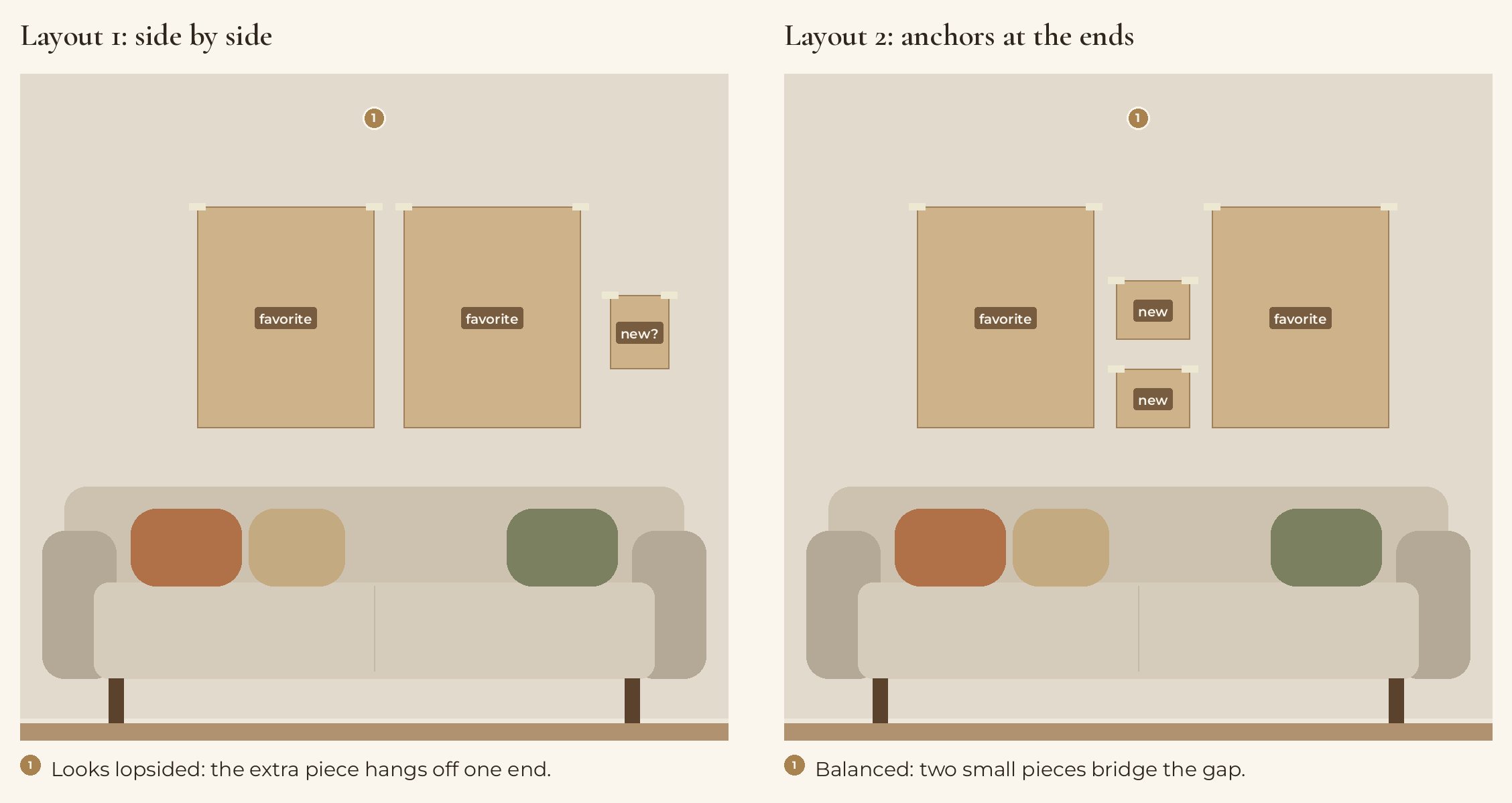
Put one at each end and bridge the gap with a small column of prints, rather than pushing the two big pieces together.
Two large pieces side by side with nothing else tend to look like two separate walls, especially if their styles differ. A narrow column of small prints between them (two 8 × 10"s here) makes one composition. Echo one color from each favorite in the small prints so all three parts connect.
How do you build a gallery wall around a mirror?
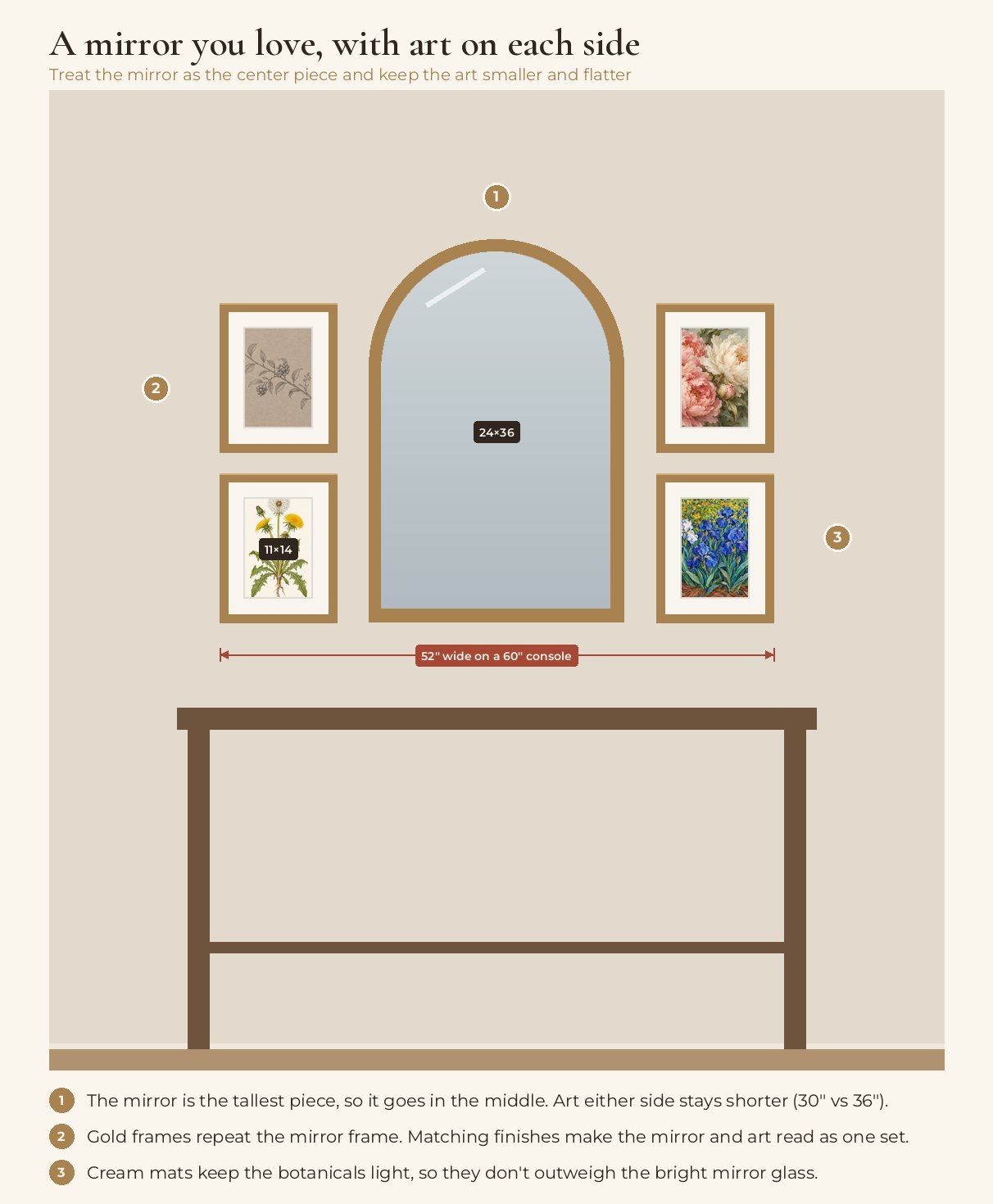
Put the mirror in the center as the tallest piece, flank it with smaller, lighter art, and repeat the mirror's frame finish.
A mirror is visually heavy: bright glass plus a strong frame. Art next to it should be shorter and calmer, so it supports rather than competes. Gold frames to match a gold mirror, or black to match black, make the whole group read as one set.
How do you hang a clock in a gallery wall?
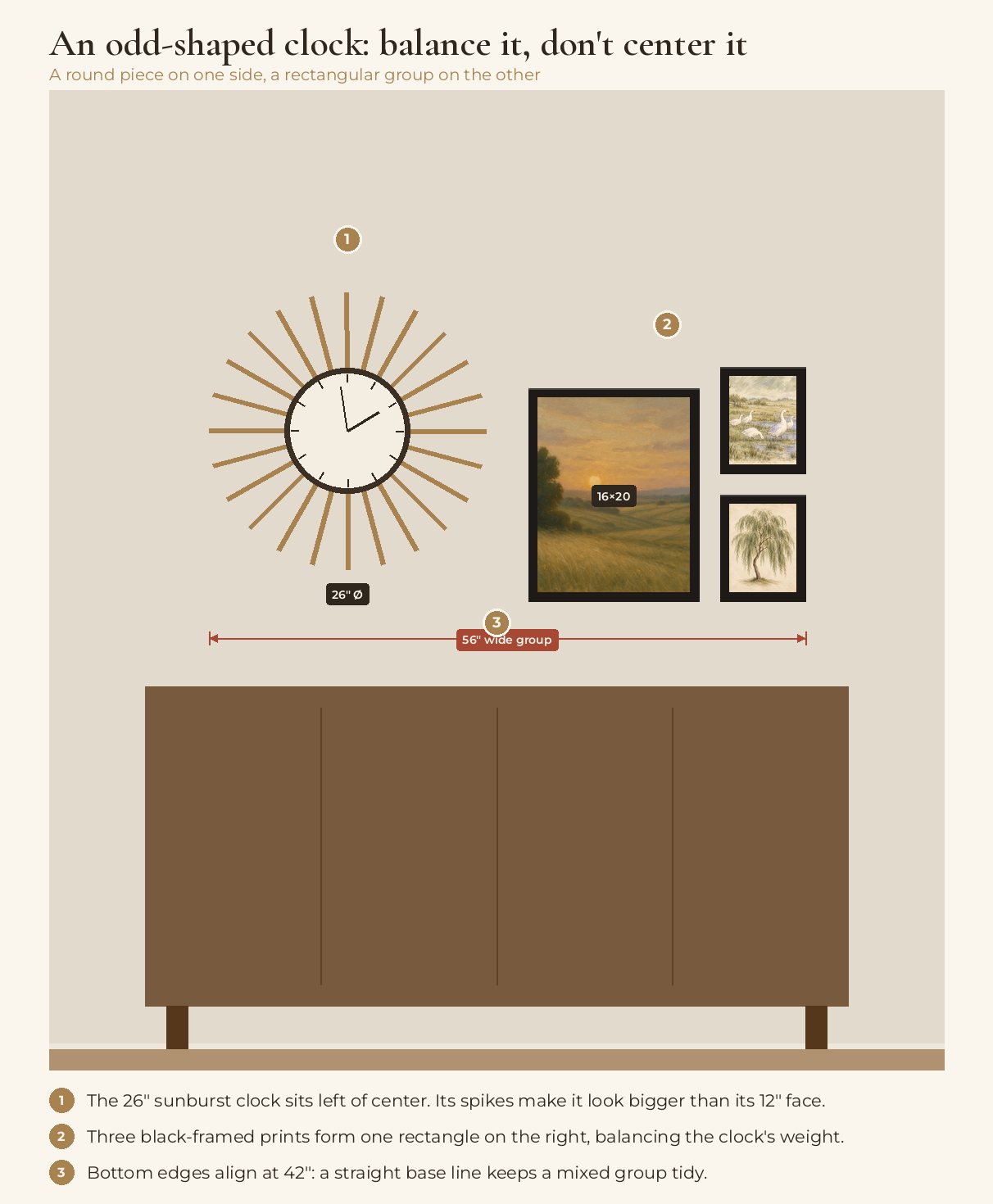
Treat an odd-shaped clock as a weight to balance, not a center: put it to one side and balance it with a rectangular group of art on the other.
Round and sunburst clocks are hard to center in a grid because their shape breaks every line. Hung off-center, the round shape becomes the contrast that makes the wall interesting. Align the bottom edges of the art to give the mixed shapes a common base line.
What is visual weight, and why does it matter?
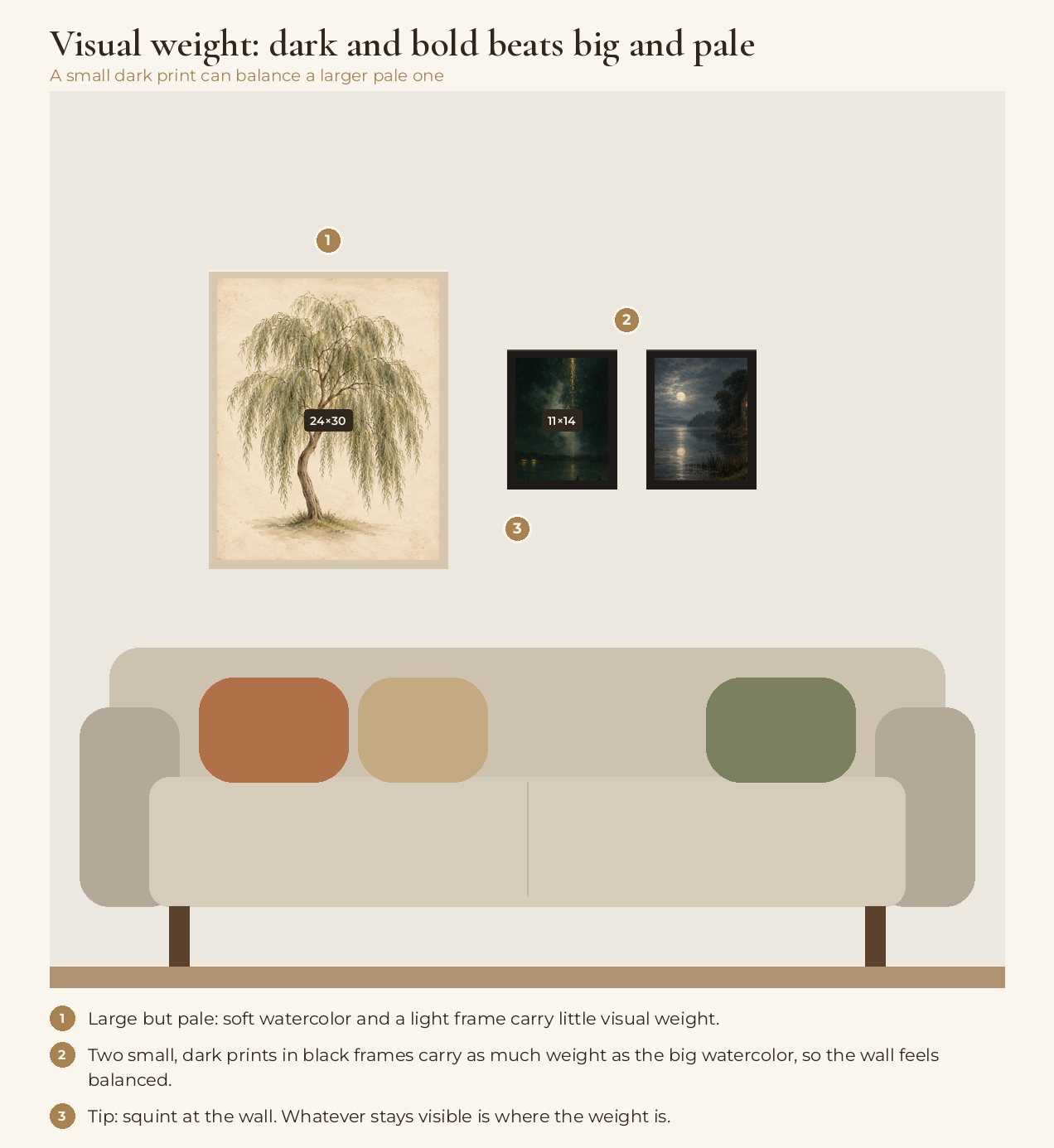
Visual weight is how strongly a piece pulls the eye. Dark, high-contrast or heavily framed pieces weigh more than large, pale ones.
This is why a "balanced" wall sometimes looks lopsided: the pieces are balanced by size but not by weight. A large, pale watercolor in a light frame can be balanced by two small, dark prints in black frames on the other side.
Swipe or scroll sideways to read the full table.
| Feels heavier | Feels lighter |
|---|---|
| Dark backgrounds, night scenes | Pale watercolors, sketches on cream |
| Black or dark wood frames | Light oak, white or thin gold frames |
| Bold, saturated color | Soft, muted color |
| No mat | Wide cream or white mat |
| Mirrors and shiny objects | Matte prints |
How should the arrangement relate to the furniture below?
Make the whole group about two-thirds of the furniture width, centered on the furniture, with the lowest edge 8–10 inches above it.
Measure the group as one shape, including the gaps, and check it against what's below. Above a 96" sofa, aim for roughly 60–64"; above a 60" console, about 40–52". If your favorites alone fall short, that tells you how much to add. The sofa size chart covers every common furniture size.
What if your favorite piece is too small for the wall?
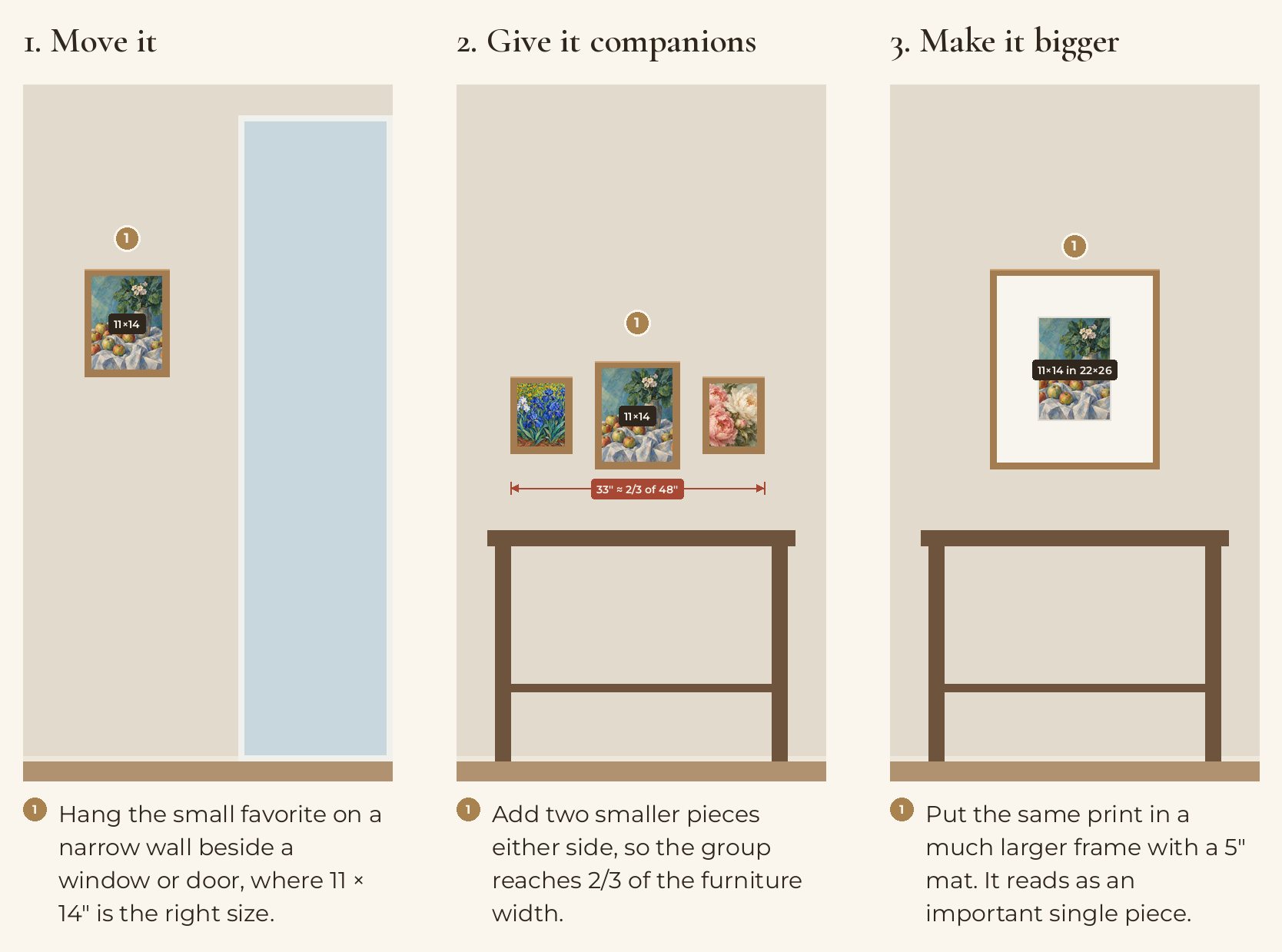
Move it to a smaller wall, give it companions, or make it bigger with a larger frame and a wide mat. Replacing it is the last option, not the first.
An 11 × 14" favorite above a long sofa looks lost, but the piece isn't the problem; the wall is. Three fixes:
- Move it: a narrow wall beside a window or door, a bathroom or a hallway, where its size is right.
- Give it companions: two smaller prints either side so the group reaches two-thirds of the furniture width.
- Make it bigger: re-frame it in a much larger frame with a 4–5" mat. A small piece in a big mat reads as precious, not undersized.
How do you test the layout before buying anything else?
Cut full-size paper templates of every piece, tape up two different arrangements, and compare them for a day or two.
- Trace each piece on kraft paper or wrapping paper and cut it out at full size, frame included.
- Mark where the hanging hardware sits on each template, so you can nail straight through the paper later.
- Tape up arrangement one, take a photo, then move the templates to arrangement two and photograph that too.
- Compare the photos side by side. The better one is usually obvious at phone size.
- Only then decide what, if anything, you need to buy to fill the gaps.
FAQ
How do you make a gallery wall with a mirror?
Center the mirror as the tallest piece, flank it with smaller and calmer art, and repeat the mirror's frame finish (gold, black or wood) in the art frames.
Can you put a clock in a gallery wall?
Yes. Round or sunburst clocks work best off-center, balanced by a rectangular group of art on the other side, with bottom edges aligned.
How do you balance two large pictures on one wall?
Hang one at each end at the same height and connect them with a small column of prints between, so they read as one composition rather than two.
What do you do with a picture that is too small for the wall?
Move it to a smaller wall, add two smaller companion pieces to make a group, or re-frame it in a much larger frame with a wide mat.
What does visual weight mean in a gallery wall?
How strongly a piece pulls the eye. Dark, bold and heavily framed pieces feel heavier than large pale ones, so balance by weight, not just size.
More styling guides
Add only what the wall needs
Small vintage prints are the easiest way to bridge, balance and frame the pieces you already love.
Browse the collections Visit the Etsy shop