Gallery walls
How to Mix Family Photos and Art Without Making Your Gallery Wall Feel Cluttered
To mix family photos and art without clutter, keep the number small, give everything one shared element (the same frame finish, the same mat color, or black-and-white photos), and shrink the photos with wide mats rather than filling the frames. Measure the whole group, frames and gaps included, before you hang it.
The art is chosen. The photos are meaningful. Together on one wall, they look like two collections in a fight.
Mixing personal photos with art prints is one of the most common gallery wall questions, and it doesn't need matching frames for everything. It needs a starter selection, one visual link and enough breathing room. Here are three measured layouts, plus the mat trick that makes snapshots look like part of the gallery.

How do you mix family photos and art on one wall?
Start small, connect everything with one shared element (a frame finish, a mat color or a repeated color), and give the photos more breathing room than the art.
Photos and art look cluttered together for one reason: there's nothing tying them to each other. A matching trio of prints has its own logic; a dozen snapshots have theirs. Put them side by side without a link and the wall reads as two collections fighting for the same space.
- Pick a starter set. Three to six photos you actually love, not every frame you own. You can rotate the rest later.
- Choose one connector. The same frame finish, the same mat color, or photos printed in black and white so the color comes from the art.
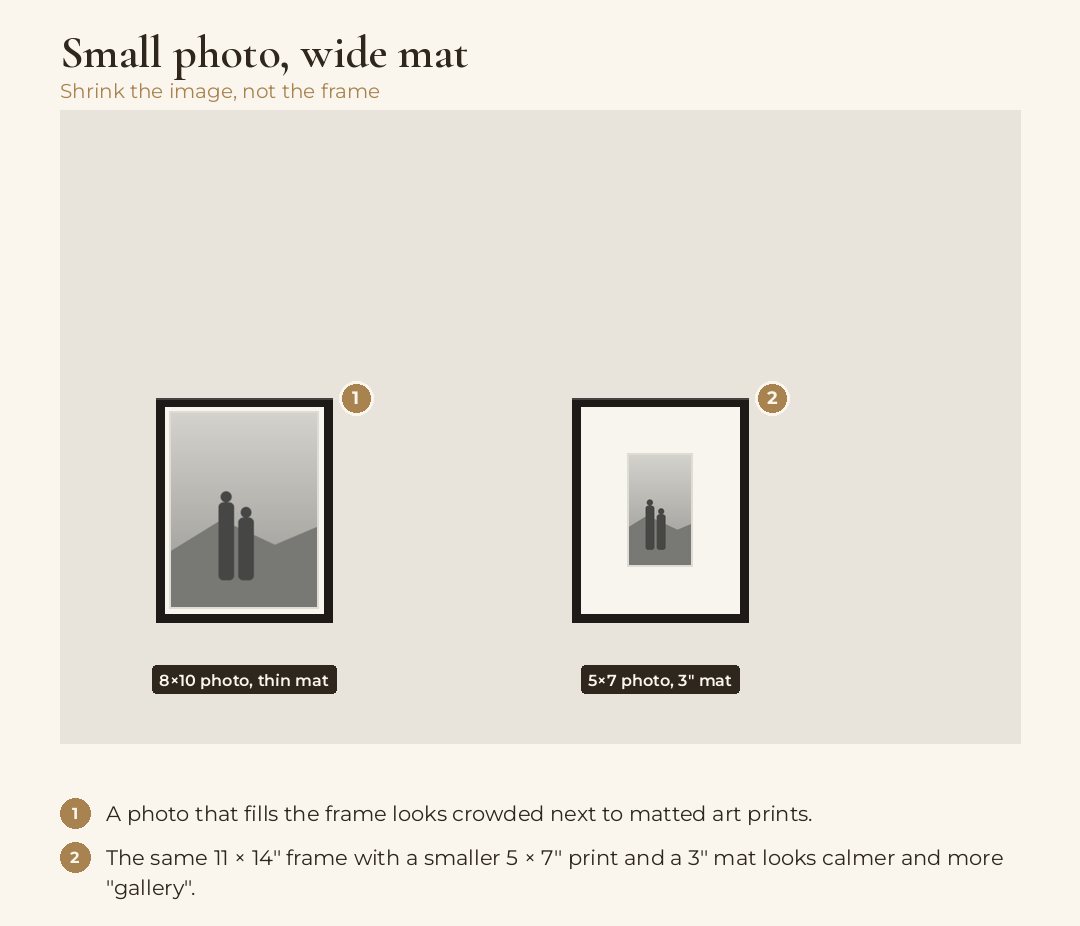
- Shrink the photos, not the frames. A 5 × 7" photo in an 11 × 14" frame with a wide mat looks calmer than an 8 × 10" photo filling it.
- Measure the whole group, frames and gaps included, before the first nail goes in.
How do you add photos to a matching set of three prints?
Keep the trio together and centered, and add the photos as a separate, narrower row above or below it in the same frames.
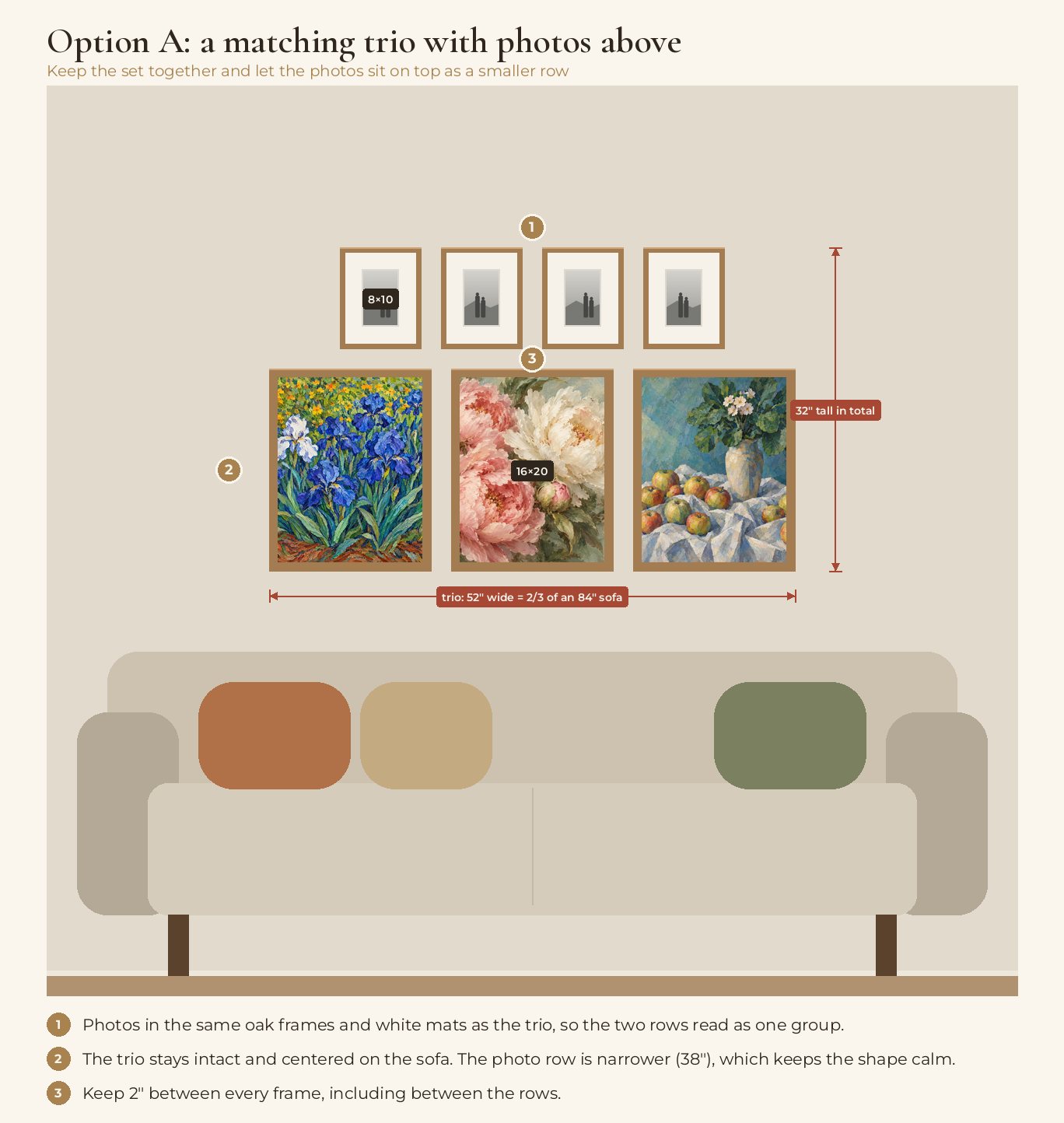
Breaking up a matching trio to slot photos between the prints loses what made the set work. Instead, treat the trio as the base and stack a smaller row of photos on top. The diagram below uses three 16 × 20" botanicals over an 84" sofa, with four 8 × 10" photos above.
What sizes does the trio-plus-photos layout use?
Three 16 × 20" prints and four 8 × 10" photo frames: 52" wide and 32" tall in total.
Swipe or scroll sideways to read the full table.
| Piece | Frame size | Count | Row width |
|---|---|---|---|
| Art prints (trio) | 16 × 20" | 3 | 52" (2" gaps) |
| Photos | 8 × 10" (5 × 7" photo, wide mat) | 4 | 38" (2" gaps) |
| Whole group | — | 7 | 52" wide × 32" tall |
Hang the trio's bottom edge 8–10" above the sofa back, then the photo row 2" above the trio. For the sizing rule behind the 52", see what size art above a sofa.
What if the wall is narrow?
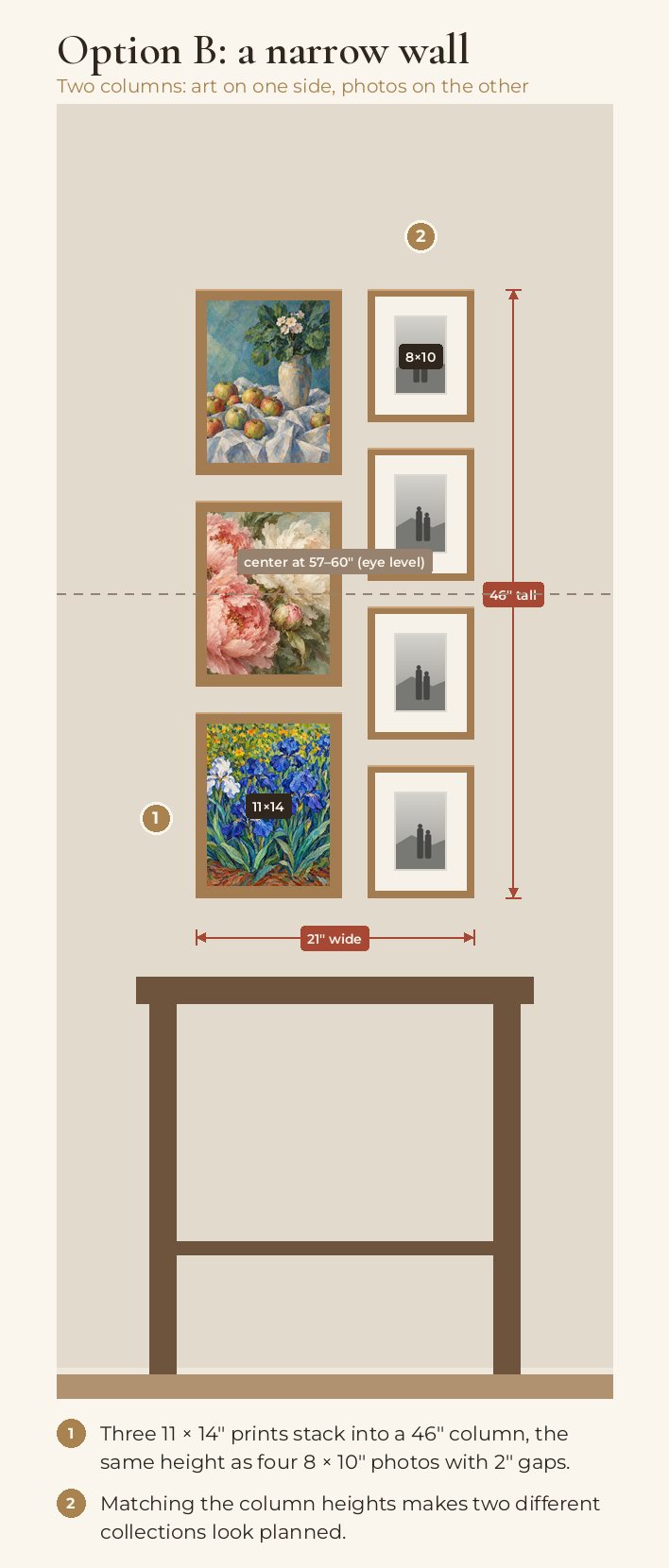
Go vertical: one column of art and one column of photos, built to the same height.
Beside a door, in a hallway or between two windows, a wide arrangement won't fit. Two columns will. Three 11 × 14" prints with 2" gaps make a 46" column, exactly the height of four 8 × 10" photos with 2" gaps, so the two sides line up top and bottom.
How do you stop a busy mix from looking cluttered?
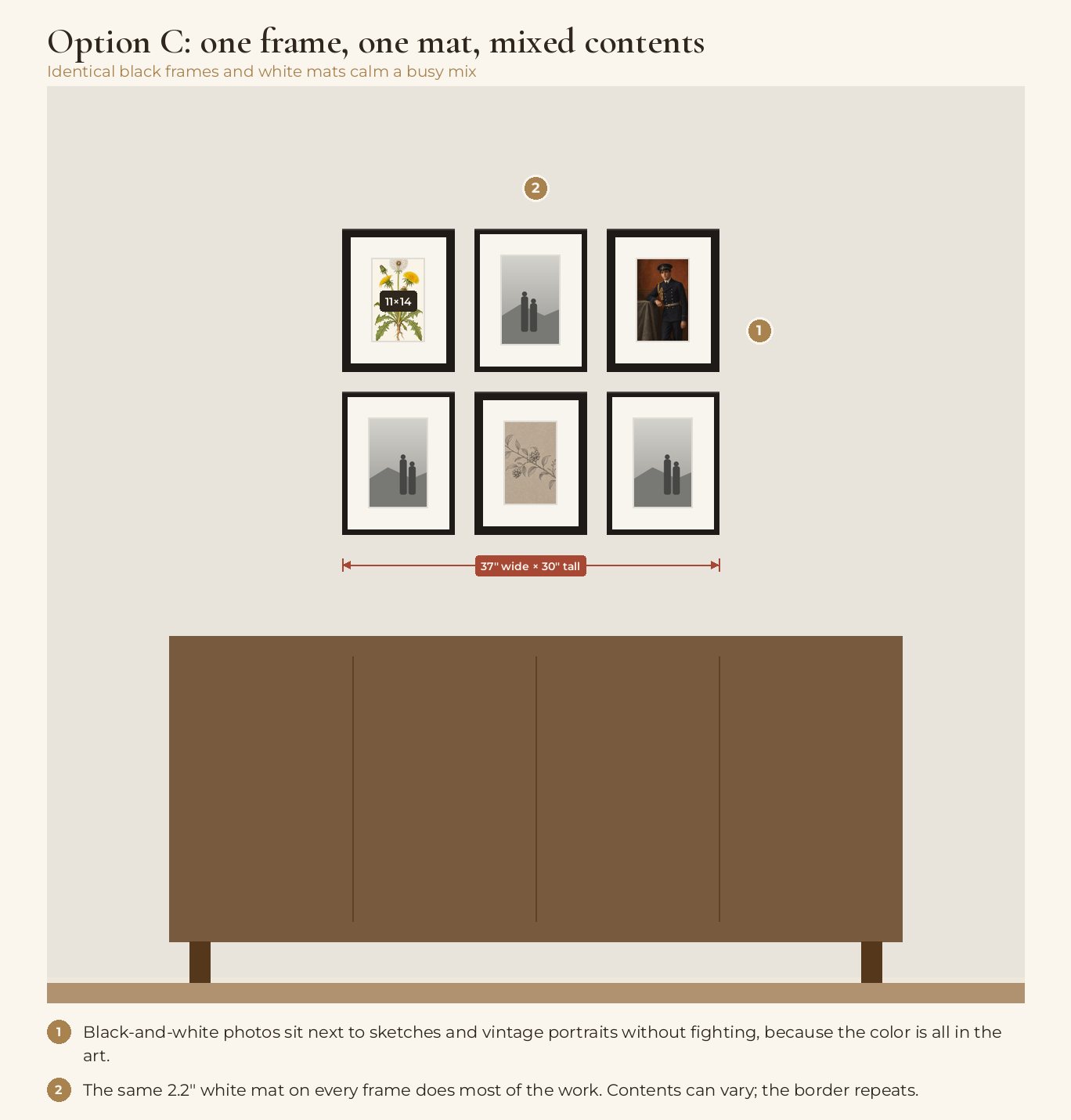
Use the same frame and the same mat on everything, and print color photos in black and white.
When the contents are all different (snapshots, vintage portraits, a botanical sketch), the border has to do the organizing. Identical black frames with identical white mats turn a random set into a grid. Black-and-white photos help even more: the color then comes only from the art, and the photos read as calm neutrals.
Should you hang every family photo or rotate them?
Hang a small selection and rotate. A wall of every photo you own is where clutter comes from.
Swipe or scroll sideways to read the full table.
| Approach | Best for | Watch out for |
|---|---|---|
| Keep every frame up | A hallway "family wall" with one consistent frame | Mixed frames and sizes quickly look messy |
| Small selection, rotate seasonally | Living rooms and above sofas or beds | Keep spare photos printed to the same size so swaps are easy |
| Picture ledge | Renters, and anyone who changes photos often | Overlap frames slightly so it looks styled, not stored |
Standard frame sizes make rotation painless: print new photos to the same 5 × 7" and swap them behind the mat. A picture ledge is the easiest way to do this in a rental; see our renter-friendly gallery wall guide.
How do you measure a photo and art wall before hanging?
Measure the whole group, frames and gaps included, and check it against the furniture: about two-thirds of the width below.
- Add up frame widths plus 2" gaps for the total width.
- Do the same for height, including the space between rows.
- Compare with the furniture: the group should be about 2/3 of the sofa, bed or console width.
- Cut paper templates to each frame size, tape them up, and live with them for a day before drilling.
For ready-made templates with exact measurements, see our gallery wall layouts for 3, 4, 6 and 9 prints.
FAQ
Can you mix family photos with art on the same wall?
Yes. Connect them with one shared element (the same frame finish or mat color, or photos printed in black and white) and keep the photo count small.
Do all the frames need to match on a photo and art wall?
No. One shared element is enough: the same finish, the same mat color, or a repeated color. Fully matching frames is only one way to do it.
How much space should be between frames on a gallery wall?
About 2 inches between frames, including between rows. Larger gaps make the group look scattered.
How big should a photo and art wall be above a sofa?
About two-thirds of the sofa width. Above an 84 inch sofa, that's roughly 52–56 inches including frames and gaps.
More styling guides
Find the art half of your wall
Vintage botanicals, landscapes and still lifes that sit happily next to family photos.
Browse the collections Visit the Etsy shop