Art beside living plants
Vintage Botanical Prints with Houseplants: Plan Around Leaves, Light and Access
Place the living plant where its care needs work, then plan the pictures around the visible leaves and your daily access. Judge the plant and art as one composition without expecting the plant to stay the same shape.
A plant and a botanical picture can share a subject while competing for the same space. The pot fits beside the sideboard, but a leaf hides the image; the shelf looks tidy until you try to water it. The missing step is to plan the moving, functional part of the arrangement before fixing the art.
This guide focuses on that changing silhouette and care routine. It goes beyond matching green colors or choosing pictures for a kitchen wall.
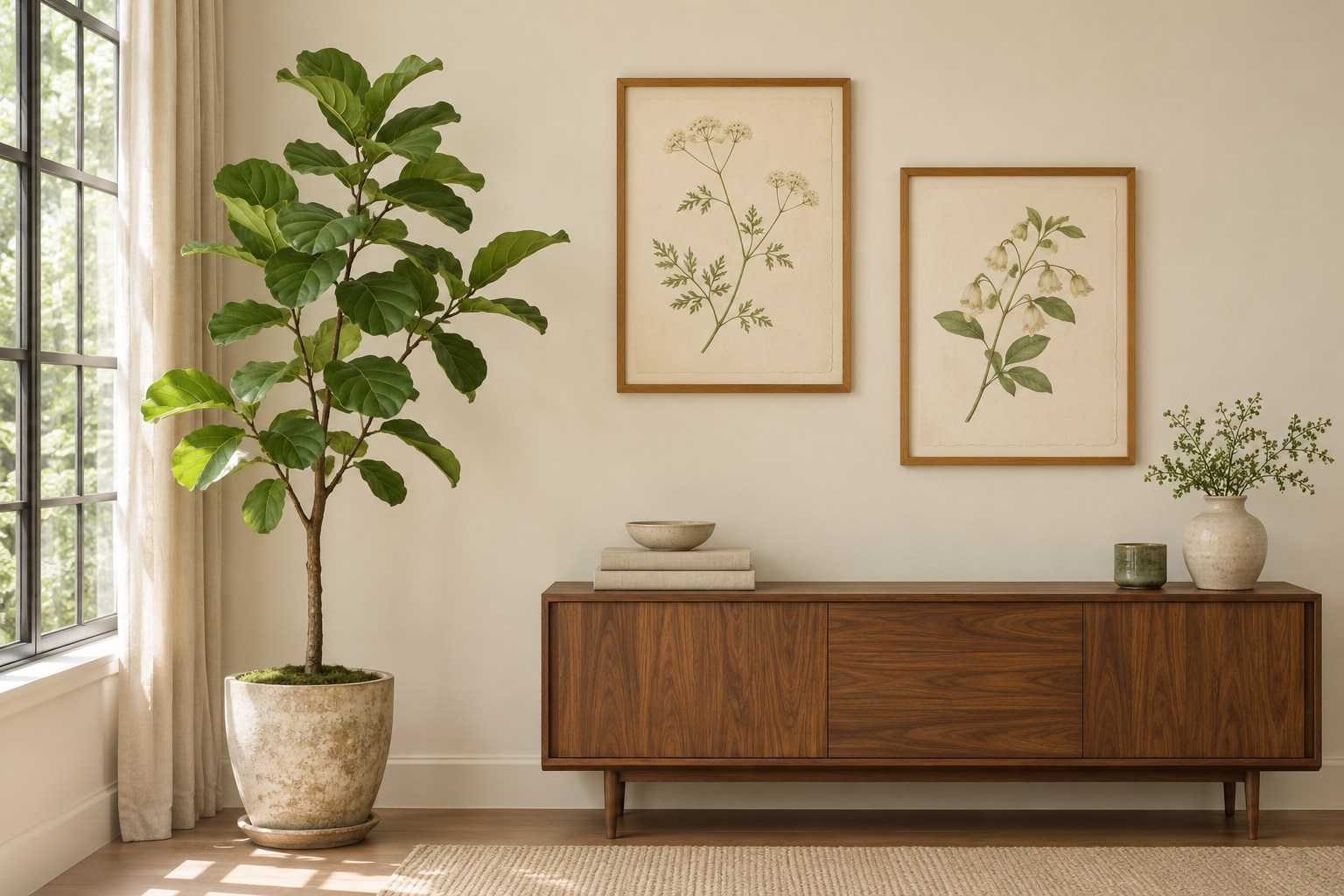
Let the plant’s needs set the starting position
Choose a workable place for the living plant before you assign the remaining wall to pictures. A position that looks balanced in a photograph may be unsuitable for that particular plant. The RHS identifies light, humidity and temperature as key conditions to consider when choosing houseplants. Follow plant-specific guidance rather than moving a plant into a dark corner to make the art look symmetrical.
Art has its own display needs. For paper-based work, the Library of Congress recommends avoiding direct sunlight and environmental extremes. The practical answer can be to keep the plant near its suitable light and put the pictures on an adjacent wall. They can belong to one corner without sharing precisely the same spot.
Record the everyday tasks too: opening curtains, reaching a window handle, watering, lifting a pot and cleaning the surface. Choose a layout that still works while you do those things. This is a composition plan; shelf loading, fixing methods and grow-light installation require advice for the actual equipment.
Measure the canopy, not only the pot
A pot may occupy a small circle while the leaves fill much of the view above it. Stand at the doorway and at your usual seat, and note the plant’s visible left edge, right edge and top. A straight-on photograph alone may hide leaves that overlap a picture from the side.
Mark the current outline on a sketch or a room photograph you own. Then mark a second outline that represents the space you want to keep available for leaf movement, access or future adjustment. That second outline is a planning allowance you choose, not a prediction of how much the plant will grow.
Do this for trailing plants as well: the useful boundary includes the hanging stems, not just the shelf. If you regularly turn or move the plant as part of its care, compare the art with those ordinary positions rather than designing around one carefully posed leaf.
Choose a relationship between the leaves and the pictures
Swipe or scroll sideways to compare the three approaches.
| Approach | What the plant does | What the art does | Compare before committing |
|---|---|---|---|
| Separate neighboring zones | Keeps its care position near a suitable window | Forms a small group on the adjacent clear wall | Whether both read together from your seat |
| Plant as the main silhouette | Supplies height and fullness | Uses one quieter study with open background | Whether the picture stays visible from the doorway |
| Art as the main group | Adds one restrained living accent | Provides the stronger sequence or color | Whether the pot or foliage interrupts the important image details |
You do not need to match the pictured species to the living one. You might repeat the long shape of a leaf, a restrained green, or the warmth of the pot in a frame. If the plant already has broad patterned foliage, an airy study may give you a calmer comparison than another dense mass of leaves.
For choosing several printed images, use our botanical set-selection guide. Here the extra decision is which part of the composition changes as the living plant moves and is cared for.
A worked wall plan: keep the art outside a chosen plant zone
Consider a hypothetical 72-inch-wide wall section. You reserve the left 30 inches for the plant’s visible outline and your chosen adjustment space. The remaining section is 42 inches wide. Two finished frames, each 14 inches wide, with one trial gap of 3 inches occupy 31 inches: 14 + 3 + 14.
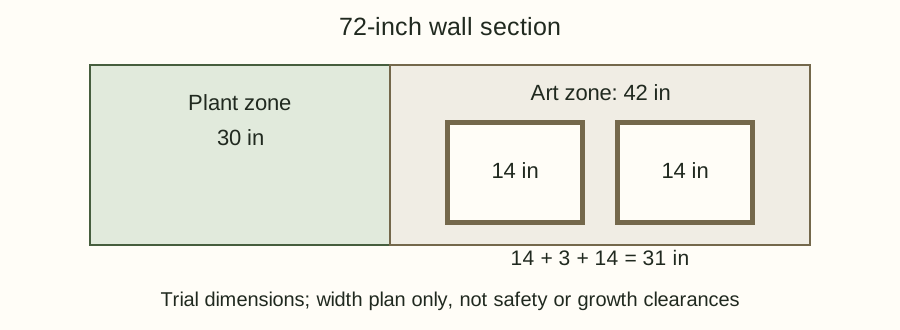
Centering the 31-inch group in the 42-inch section leaves 5.5 inches at each side. This checks the width arithmetic; it does not establish that 5.5 inches is enough for watering, growth or your particular frame installation. Compare your own canopy and access needs first, and adjust the zone or reduce the number of pictures if necessary.
Also compare one frame in that same section. Leaving the rest of the wall open may make the plant and picture easier to read. You do not have to fill the space released by moving a plant.
Keep the care routine visible in the plan
Try the arrangement during an ordinary watering or cleaning session before buying extra art. Can you reach the pot without touching the picture? Does a trailing stem catch the frame when you move it? Do you have to relocate every object to open the curtain?
Keep water handling away from paper and frame surfaces. Choose a separate watering area if that is how you can manage the task reliably, and follow the plant’s care advice. Do not treat a glazed frame as waterproof or use a decorative arrangement as a reason to add an unverified shelf or electrical setup.
If the corner is a working plant shelf rather than a display sideboard, treat that function as fixed. One small art group beside the shelves may be more useful than squeezing pictures between pots, equipment and growing plants.
Recheck the composition when the plant changes
When you notice leaves overlapping an image, compare the current arrangement with your original sketch. Decide whether a picture can move, one companion can leave the group, or the art belongs on the neighboring wall. Avoid treating pruning or a change of plant position as the automatic decorating fix; those choices should suit the plant as well.
At the next seasonal room reset, revisit light, access and the view from your seat. You are checking whether the layout still works, rather than expecting a living plant to remain the same size as the day you styled the corner.
- Plant position
- Care requirements checked: ______ Window/curtain access: ______
- Current silhouette
- Visible width and height from seat: ______ From doorway: ______
- Space I choose to keep free
- Care route and adjustment zone: ______ Why: ______
- Art plan
- One picture / pair / neighboring wall: ______ Finished frame widths and gaps: ______
- Routine check
- Watering, cleaning and ordinary plant movement still work: ______
- Next adjustment trigger
- Leaf overlap / changed light / blocked access / other: ______
Browse vintage botanical prints on Etsy once the usable art space is clear. Choose the image for that space, rather than moving a well-positioned plant to accommodate a bundle.