TV art collection planning
Build a Small Year-Round TV Frame Art Collection
Start with a TV artwork you would happily leave on display, then add another only when it serves a different use you actually have. Keep a short selection record so your collection remains easy to choose from after the holiday files are put away.
A large bundle can offer variety without giving you a useful choice. Six similar landscapes may all suit the same moment; a single favorite may serve you better than a folder full of compromises. Plan the collection around the decisions you want to make, rather than a required number of downloads.
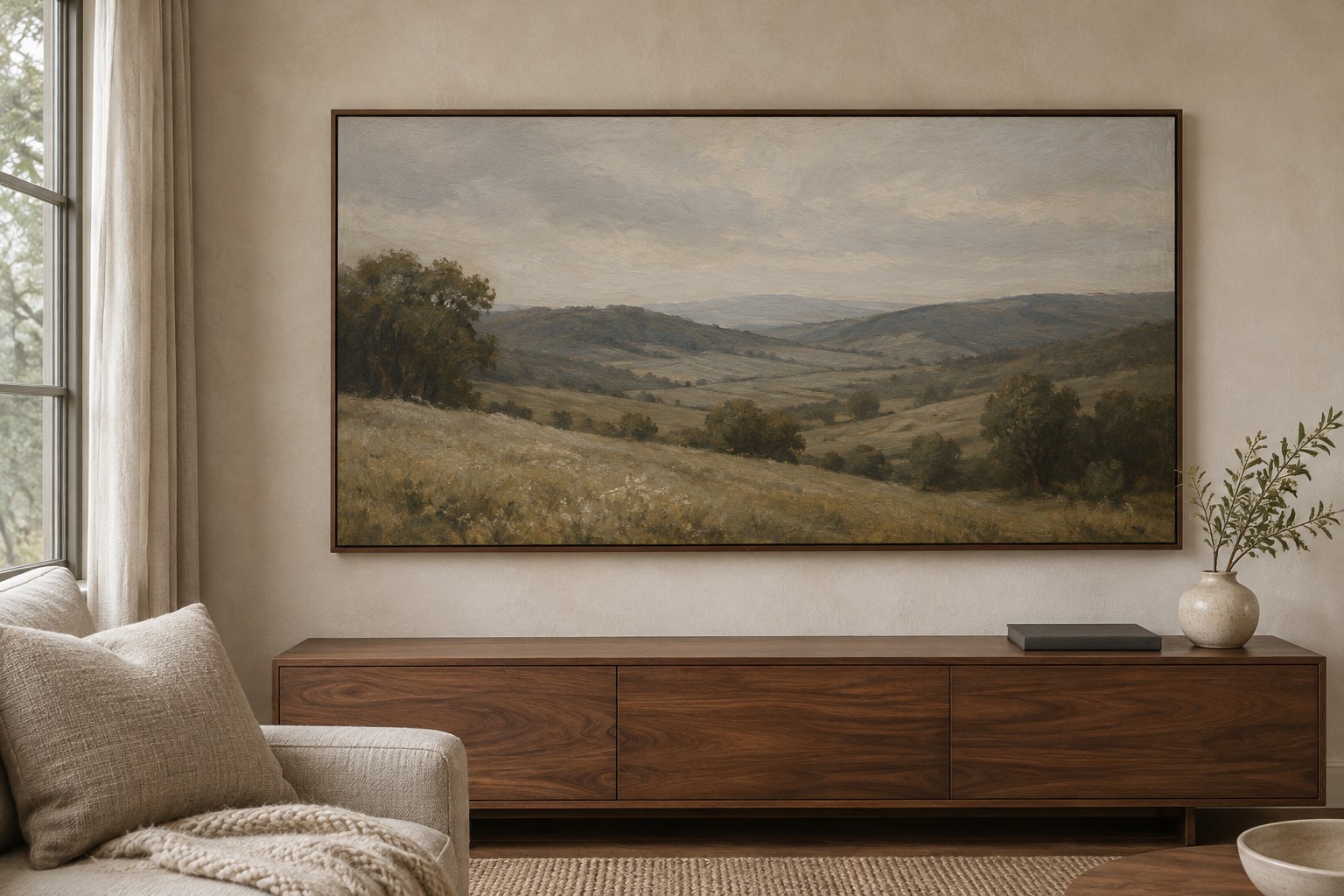
Give your first image the everyday role
Choose an image you like with the room as it normally looks: ordinary cushions, familiar furniture and no temporary decorations. Ask, “Would I still choose this after the occasion has passed?” A landscape, a still life or an abstract can work; the subject category alone does not make an image suitable all year.
Record why this image earns its place. “I enjoy the open view from the sofa” is useful. “It was included in the bundle” is not a reason you will use later. You do not need to keep changing art just because your display can change it.
If you already have a favorite, start there. Buying a replacement collection before checking the files you own can give you another version of a choice you have already made.
Define a second use before buying a second file
Think of a real occasion when you would want a different image. You might want a less detailed picture behind a busy dining table, a subject with personal meaning for a gathering, or simply a change from an image you see every day. These are optional uses, not a list of slots to fill.
Use this sentence: “When ______, I would choose ______ instead of my everyday image because ______.” If you cannot finish the last part, keep the candidate on a wish list. A new filename or a slightly different tree does not necessarily give you a new choice.
Keep holiday art in a separate optional group. A winter landscape might be an everyday favorite, but a picture chosen mainly for a dated celebration need not define the rest of your collection.
A worked collection brief: three candidates, not three obligations
Imagine an owner who likes an open hill view for ordinary evenings, wants a quiet alternative when the console carries flowers and books, and sometimes wants a flower study with a family connection. The following is a planning example, not a tested collection or a required three-image formula.
Swipe or scroll sideways to compare each candidate’s purpose.
| Proposed role | Candidate | Keep only if |
|---|---|---|
| Everyday return point | Open rolling-hill landscape | The owner enjoys it with the usual room furnishings and from the main seat |
| Less visual detail | Restrained wash of sky and water | It offers a welcome change when the surroundings are busy, rather than merely looking like a paler version of the first image |
| Personal occasion | A flower study linked to a shared interest | The subject matters to the owner and remains enjoyable on the actual display |
If the seascape never feels preferable, leave it out. If the flower study is too detailed to enjoy from the sofa, look for another composition rather than keeping it solely to finish a set. Two useful images form a more deliberate collection than three with one unused compromise.
Audit a bundle before comparing its price
Look at the flat previews and list the distinct artworks. A download may supply several ratios or sizes of one picture. Count those as file versions of that artwork, not additional choices for your collection.
- Mark favorites independently. Which images would you choose if there were no bundle?
- Assign each favorite a use. Use the sentence above. Put candidates with the same purpose beside each other.
- Choose between near-duplicates. If both would be your everyday landscape, decide which you prefer. Keep both only if you value the difference.
- Check the supplied files. Confirm the exact versions, compatibility information and any borders rather than relying on the styled listing photograph.
- Compare the complete purchase. Compare the bundle’s actual cost with buying the images you want separately. More downloads are not automatically better value for you.
A hypothetical bundle with twelve files might contain four artworks in three versions each: twelve files, four pictures. If you want only two of those pictures, the other two artworks do not establish value on their own. Check the listing’s actual contents; this example does not describe any particular seller’s offer.
Keep originals and display choices easy to identify
Save the original purchased downloads with the seller’s instructions and the terms supplied with that purchase. Keep your order reference or receipt privately. When preparing an allowed display version, use a separate copy so you can identify the original file later.
A simple personal folder can separate Original downloads, Chosen display files and Selection notes. This is an organization suggestion, not a folder structure every television will recognize. Follow your device’s instructions for transfer and storage.
Name a chosen file so you can distinguish artwork and version, for example hill-view_selected-wide.jpg. Record the actual pixel dimensions and file type in your notes. A name containing “wide” or “4K” does not verify what the file contains.
If your model offers favorites or collections, use those features according to its instructions. You can also keep a shortlist outside the TV. This plan does not depend on automatic slideshows, a subscription or a feature shared by every brand.
Check the permission attached to each image
Before buying, read what the seller says is included and how the file may be used. Do not assume a digital download includes permission to redistribute it, place it in a public business setting or change it. If your intended use or crop is unclear, ask the seller before proceeding.
Keep the answer with the purchase record. If an image comes from a subscription service, check that service’s current access terms separately rather than treating it as the same kind of purchase as a downloaded file. Do not make continued access depend on a guess.
For example, Samsung Australia’s Art Mode guidance states that access to Art Store artwork ceases when that subscription ends. Check the current terms for the service you use and your own model and region; that statement does not describe every source of TV art.
Use a small collection card instead of a long shopping list
- Everyday image
- Artwork: ______ Why I return to it: ______
- Another use I actually have
- When: ______ Alternative artwork: ______ Why it is preferable then: ______
- Duplicate check
- Which existing picture serves the same purpose? ______ Keep one / keep both for this reason: ______
- Purchase and file record
- Seller and order reference stored privately: ______ Original filename: ______ Chosen version and actual dimensions: ______
- Usage check
- Intended use permitted: ______ Terms or seller response saved: ______ Access dependent on a subscription: ______
- Display preference
- Chosen presentation, if supported: ______ Details checked from my seat: ______
When another image catches your attention, compare it with this card. Add it because it gives you a choice you want, or replace an image you no longer prefer. You do not need a larger library simply because a new season arrives.
For the individual file decision, use our TV art crop-and-fit guide. For the relationship to the room, see choosing a palette for your room and bezel. Those checks help you select each picture; this collection plan helps you decide which pictures deserve a place at all.