Three-print planning
Set of 3 Prints: How to Choose, Size and Arrange Your Trio
Choose a set of three for the relationship between the pictures, then plan the complete framed group. Compare the images together, try more than one order, and include frames, mats and gaps when deciding whether the trio suits your wall.
A set of three gives you a manageable number of choices: enough pictures to build a sequence, without planning a large gallery. The useful question is what the three do together. A favorite landscape, a complementary sketch and a quieter painting can make a satisfying group; three individually attractive pictures can also feel disconnected.
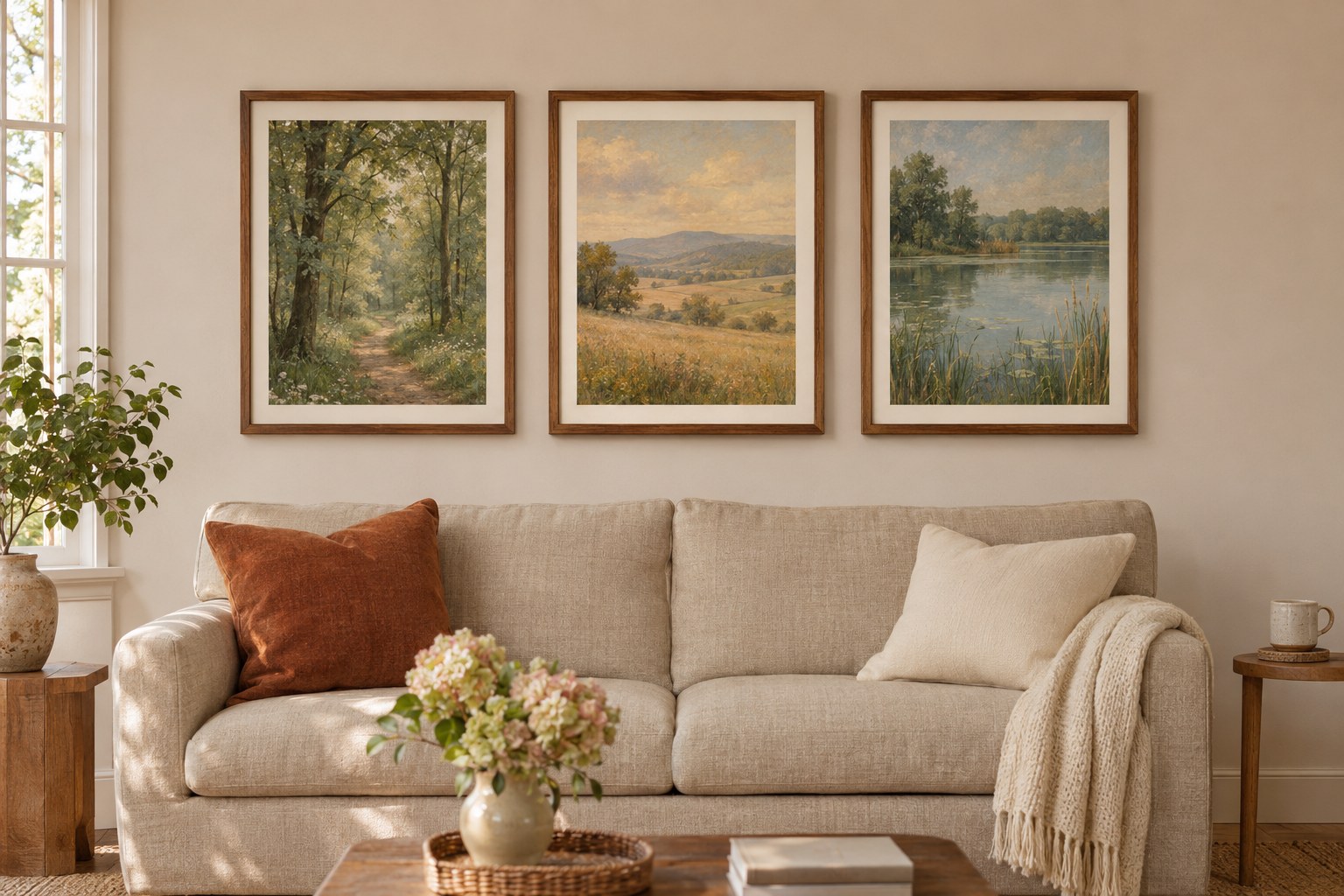
First decide what kind of set you are buying
Check whether the listing contains three independent images, a coordinated series or one connected image divided across three panels. That distinction affects the order and the ways you can rearrange it later.
With independent images, you can compare several sequences or move one picture elsewhere. A coordinated series may share a subject or treatment while each picture still stands alone. A connected image asks you to preserve its intended order and understand how its composition continues across the gaps.
Look at all three flat artwork previews, rather than only the room mockup. Ask whether you enjoy each individual image and the whole group. If the third picture feels like a compromise, compare a pair or one larger work before buying a bundle simply to reach three.
Give the pictures a reason to belong together
Write a short description of the collection you want. “Quiet views of places I would like to walk” is a more useful filter than “three pictures for the sofa.” It helps you choose subjects and decide which otherwise attractive images to leave out.
Try one of these starting points:
- One subject, different views: three landscapes with a path, a distant view and a closer detail.
- One mood, different subjects: a muted landscape, a still life and a fine drawing with a similar quiet feeling.
- One personal connection: pictures that recall a place, an interest or a shared memory, linked by a frame finish or color.
You do not need every color, subject and frame to match. Choose the connection that matters most, then judge the rest together. If you are selecting plant studies specifically, our botanical set guide covers paper tone and the scale of the plants in more detail.
Choose the order before choosing the final position
Label three independent pictures A, B and C. Try A–B–C first, then B–A–C and A–C–B. You can work through the remaining orders if the choice is still unclear, but start with those three so you can see what changing the center actually does.
Notice whether one picture attracts much more attention because it is darker, more detailed or more strongly colored. Put it in the middle for one comparison, then at an end for another. Neither position is automatically correct: judge whether your eye enjoys the sequence or keeps stopping at one edge.
Check the scale of the subjects within the images too. A tiny pale sketch between two dense paintings may feel like a pause, or it may disappear. You can like that contrast, but see it before the frames are on the wall.
For the three landscapes in the room example, compare a warm hill scene in the center with a cooler lake scene in the center. The subjects remain related, while the emphasis changes. Treat this as a way to make a choice, not a rule that warm colors must occupy the middle.
Calculate the whole group, including the frames
A print dimension describes the print. It does not necessarily describe the outside of the frame you will hang. A mat and moulding can change the finished footprint, so confirm the actual outside measurements before testing the arrangement.
For a horizontal row: group width = outside width of frame A + gap 1 + outside width of frame B + gap 2 + outside width of frame C.
Hypothetical example: three frames each 12 inches wide, with two trial gaps of 2 inches, occupy 40 inches: 12 + 2 + 12 + 2 + 12. Three frames each 16 inches wide with those same gaps occupy 52 inches. The difference is 12 inches across the wall, even though both listings might look similar in separate mockups.
Centered above a hypothetical 72-inch sofa, the 40-inch group leaves 16 inches on each side; the 52-inch group leaves 10 inches. Compare both full-size outlines in your actual room. Those are arithmetic examples, not required proportions, gaps or installation clearances.
For a vertical arrangement, add the outside heights and the spaces between frames instead. Check where the top and bottom would land from the positions you normally use. A stack can fit a narrow section while still being too tall for the particular wall.
Use the wall to choose the layout
Swipe or scroll sideways to read the comparison.
| Layout | Try it when | Check first |
|---|---|---|
| Horizontal row | The pictures relate to a sofa, desk or sideboard. | Outside frame widths and gaps fit as one group; the images work in the chosen order. |
| Vertical stack | A narrow wall section offers more height than width. | The complete height works from your viewing position and respects nearby doors and controls. |
| One anchor with two companions | One picture is larger or more important to you. | The smaller images form a deliberate supporting group rather than isolated leftovers. |
Use our gallery-wall layout templates for additional configurations. Keep the choice connected to the furniture and the usable wall section, rather than automatically centering it across a wall interrupted by a doorway.
Compare the complete cost of the set
Before deciding whether a trio is good value, compare the same finished outcome. Three download files and three framed physical prints are different purchases. Write down what each option includes rather than comparing the headline prices alone.
For a digital set, your budget may include files, printing, frames and mats. For a physical set, check whether it arrives framed or unframed and which delivery charges apply. Do not assume three images are less expensive than buying separately; compare the actual total for your selected sizes.
If you already own suitable frames, begin with their outside dimensions and visible openings. Keeping them may be useful, but avoid choosing a crop that removes the part of a picture you love just to use a frame. Our printing guide explains how to approach the file and size decision.
Make one comparison sheet before ordering
- What connects the set?
- Subject, mood, memory, color or finish: ______
- What is being supplied?
- Independent pictures / coordinated series / connected panels: ______ Digital / physical / framed: ______
- My preferred order
- First comparison: ______ Second comparison: ______ Why one feels stronger: ______
- Outside measurements
- A: ______ B: ______ C: ______ Trial gaps: ______ Total width or height: ______
- Room check
- Furniture or wall section: ______ Doorway view: ______ Seated view: ______
- Complete cost
- Artwork + printing if needed + frames/mats + delivery: ______
- Final choice
- Keep the trio / choose a pair / use one larger work / find another companion: ______
Use the sheet to settle the image selection and finished footprint before installation. For the final fixing method, follow suitable advice for your actual wall and frame; this styling plan does not specify hardware.
A set is ready when you enjoy all three pictures together, the group fits the space and the complete purchase makes sense. Browse the vintage art collections for ideas, then check each listing for the actual files, dimensions and items supplied.